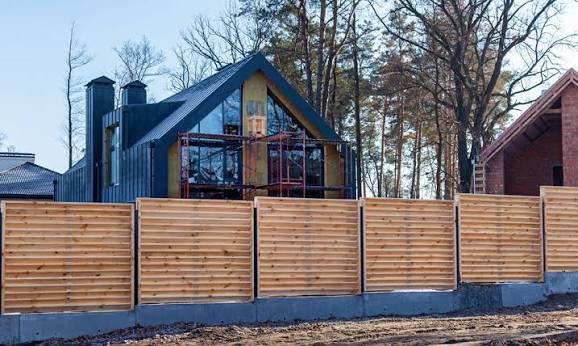
Horizontal fences have moved from high-end architectural projects into everyday neighborhoods. Their long, clean lines make a yard look wider, suit modern and mid-century homes, and give even simple properties a custom, designed feel. But turning boards sideways changes how a fence behaves. A horizontal fence that’s built like a traditional vertical fence often sags, bows, or develops uneven gaps within a few years. Getting the look right takes careful design, and getting it to last takes a few construction details that standard fences don’t need.
Why Horizontal Fences Are So Popular
- Visual width. Horizontal lines draw the eye along the length of the fence, making small yards feel larger.
- Modern style. They pair naturally with flat or low-slope roofs, large windows, and minimalist landscaping.
- Flexibility. Gap widths, board sizes, and materials can be mixed to create anything from full privacy to an airy screen.
- Custom appearance. Even with standard lumber, a well-built horizontal fence looks like a designed feature rather than an off-the-shelf product.
The Structural Challenge
In a vertical fence, each board is supported by two or three horizontal rails, and the boards themselves carry little load. In a horizontal fence, each board spans from post to post on its own, carrying its own weight plus any wind load. Wood and composite boards naturally sag over long spans, especially as they absorb moisture.
That’s why the most common horizontal fence failures are:
- Boards that dip in the middle between posts
- Boards that cup or twist as they dry
- Gaps that become uneven over time
- Posts pulled out of line by the weight of long panels
The solutions all come down to support, spacing, and material selection.
Construction Details That Make the Difference
Shorter post spacing. Traditional fences often use spacing of up to 8 feet between posts. Horizontal fences hold their lines better with shorter spans, often around 6 feet or less, depending on board thickness and material.
Mid-span support. A vertical stiffener or nailer fastened at the center of each bay gives boards a midpoint support without changing the look from the finished side.
Thicker boards. Thicker boards resist sagging and cupping far better than thin fence pickets. Many builders use dimensional lumber rather than standard fence boards for horizontal designs.
Consistent spacers. For gapped designs, using spacer blocks or a gauge during installation keeps every gap identical. Small inconsistencies are much more noticeable in horizontal lines than in vertical ones.
Quality fasteners. Stainless steel screws resist corrosion, hold boards tight as they move, and avoid the black stains that ordinary steel leaves on cedar.
A picture-frame finish. A top cap and side trim boards frame each section, hide the cut ends of the boards, and protect end grain from rain.
Choosing Materials
Cedar is the most common choice for horizontal fences. It’s stable, rot-resistant, and takes stain well, which suits modern designs in warm or dark tones.
Hardwoods such as ipe offer exceptional strength and durability, allowing longer spans with less sag, though at a much higher cost.
Composite boards resist rot and need little maintenance, but they’re heavier and more prone to sagging over long spans. They usually need close post spacing or metal support channels.
Aluminum slat systems are designed specifically for horizontal fences. They don’t sag or rot, and they come in powder-coated colors and wood-look finishes.
Mixed materials, such as wood boards between steel posts, combine warmth with structural strength.
Design Decisions
- Gap width. Tight gaps give privacy, wider gaps let in light and air. Many homeowners choose small gaps that block direct views while softening the overall look.
- Board widths. Uniform boards create a calm, sleek surface. Alternating widths add rhythm and a more custom feel.
- Height. Horizontal fences can be built to full privacy height, but a shorter version works well in front yards to define space without blocking the house.
- Color. Natural cedar feels warm and organic, while dark stains or black finishes give a sharp, contemporary edge.
- Hidden posts. Mounting boards on the face of the posts creates a continuous surface. Setting boards between posts highlights the structure.
Practical Considerations
Slopes. Horizontal boards can’t follow a slope the way vertical pickets can. On sloped yards, sections are usually stepped down, which works well visually if it’s planned from the start.
Climbing. Horizontal boards with gaps can act like a ladder. That matters for pool barriers and for families with small children, and some codes restrict horizontal designs on pool fences.
Wet climates. Horizontal boards have more surface area facing rain and more places for water to sit, so finishing and drainage matter more. In places like the Pacific Northwest, where moisture is constant, homeowners planning a horizontal fence Seattle builders install often choose thicker cedar, stainless fasteners, and a sealed top cap. Those choices keep the lines straight through long rainy seasons.
Maintenance. Gaps can collect leaves and debris, and dark stains may need refreshing more often in sunny exposures.
Gates That Match
Gates are where horizontal designs most often break down. A horizontal gate has heavy boards hanging from one side, so a rigid frame is essential. Steel frames clad in matching boards are the most reliable option. A wood gate needs a strong internal frame and diagonal bracing, and the boards should line up exactly with the fence on either side for a seamless look.
A Modern Fence Built to Stay Straight
Horizontal fences deliver one of the cleanest, most contemporary looks in outdoor design, but they reward careful construction. Shorter post spacing, mid-span support, thicker boards, quality fasteners, and a well-framed finish make the difference between lines that stay straight for years and boards that sag within a season or two.